Tub gurnard
Καπόνι · Chelidonichthys lucerna
Rules
No checked minimum size is listed for this fish. That does not mean there is none: check the current rules with the port authority before keeping a catch.
How to recognise it
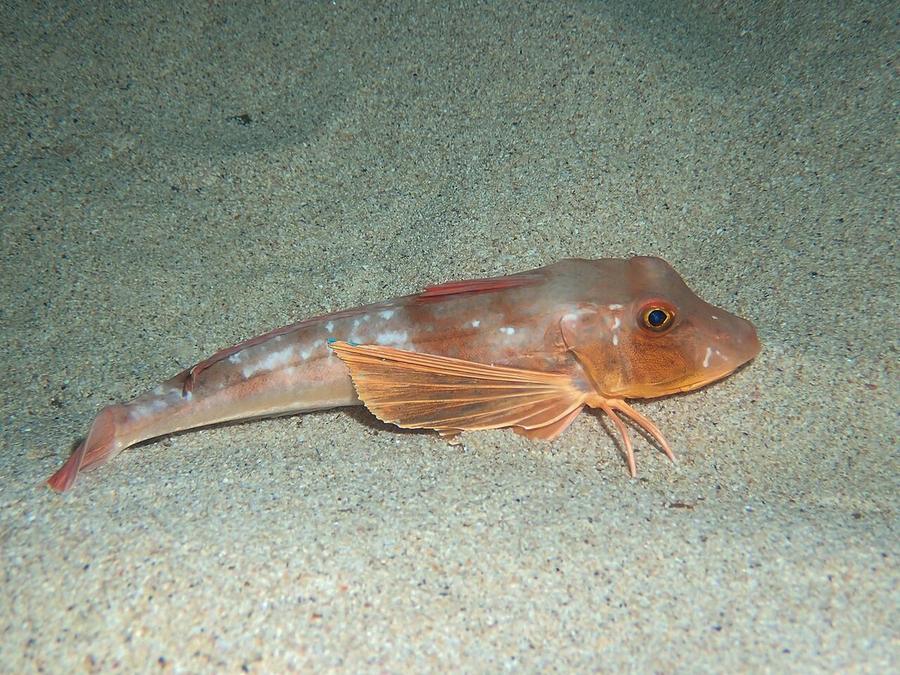
Large, angular head armoured in bone, and a body that tapers to the tail, reddish or pinkish brown with a pale belly. The pectoral fins are very large, like wings, with a bright blue edge. In front of each are three free rays, like fingers, which it uses to “walk” on the bottom.
Look-alikes
There are other, smaller gurnards, which lack such bright blue on the pectoral fins. The flying gurnard (Dactylopterus volitans) is a different fish, with even larger pectoral fins covered in blue spots.
When it is around
- Jan: Around
- Feb: Around
- Mar: Around
- Apr: Around
- May: Around
- Jun: Around
- Jul: Around
- Aug: Around
- Sep: Around
- Oct: Around
- Nov: Around
- Dec: Around
- Usual depth
- 5–150 m
- Caught by
- Bottom fishing · Handline · Surfcasting
The rest is in the app
This page is a short introduction. The Stigmo app has the full guide for this fish:
- The nearest places that suit it, ranked by distance from you
- Today's best hours, from the fishing forecast
- Step-by-step rigs for each method, with tackle sizes
- Baits and lures, and the conditions it likes
The app is being built and has not been released yet.
Draft guide, not yet checked by local anglers. Legal limits are shown only where they were read in an official source; always check the current rules before keeping a catch.